Watermark Spectrogram Comparison
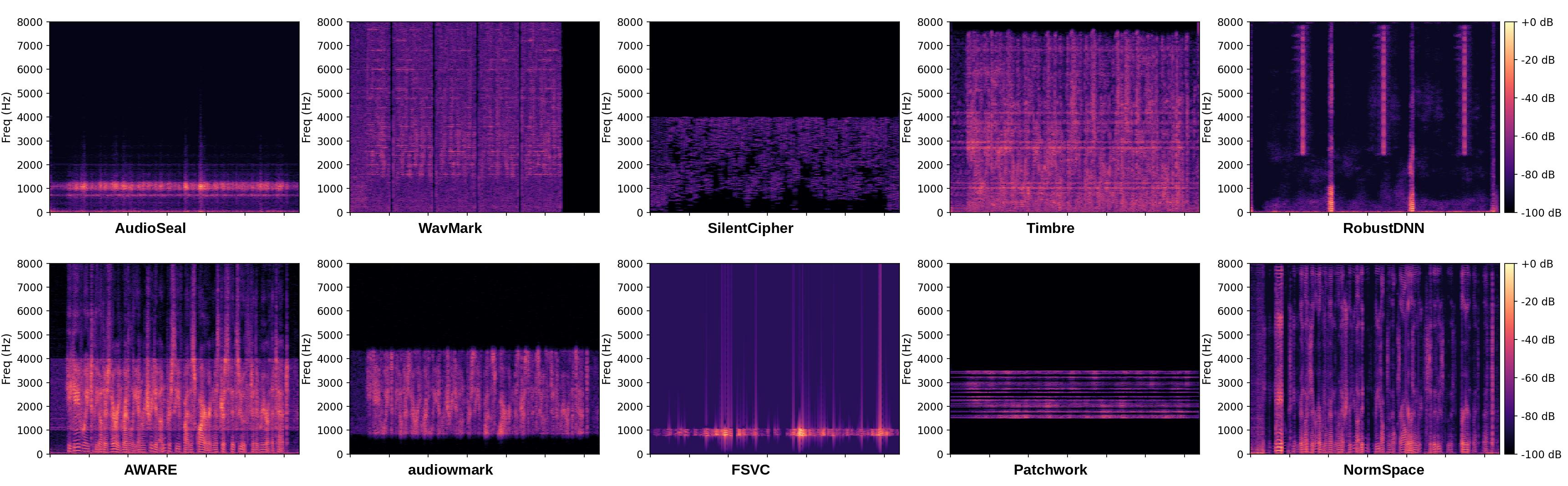
Visual comparison of where watermark energy appears across the 10 methods.
A Comprehensive Measurement Study — benchmarking 10 open-source audio watermarking methods against digital and AI-induced removal attacks.
We study whether modern audio watermarks survive practical removal attacks while preserving the usefulness of the audio, connecting a component-wise taxonomy of 26 schemes with a benchmark of 10 reproducible methods across speech and music.
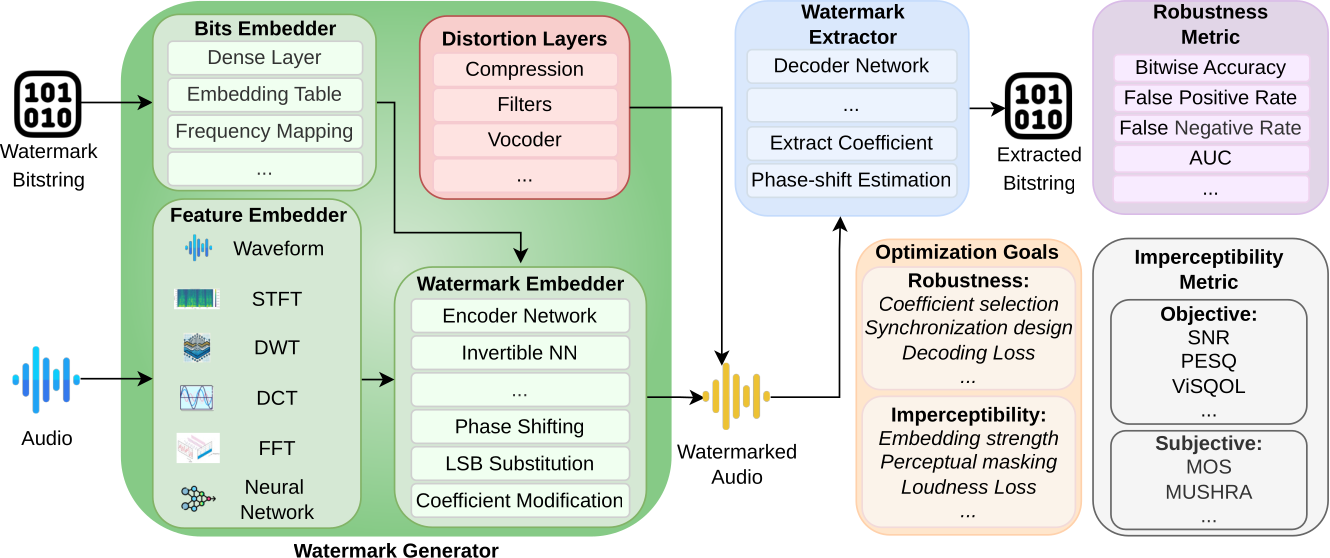
We reproduce 10 open-source watermarking methods spanning both AI-based and traditional signal-processing approaches, each with different embedding strategies and robustness characteristics.
| # | Method | Type | Watermark Pattern | Frequency Range | Message Repetition | Training Distortions |
|---|---|---|---|---|---|---|
| 1 | AudioSeal | AI | Encoder network → waveform additive | 0 – 8000 Hz | Frame level | 14 |
| 2 | WavMark | AI | Invertible Neural Network (INN) | 0 – 8000 Hz | Block level | 10 |
| 3 | SilentCipher | AI | Encoder network → waveform additive | 0 – 4000 Hz | Frame level | 6 |
| 4 | Timbre | AI | Encoder network → waveform additive | 0 – 8000 Hz | Frame level | 1 |
| 5 | RobustDNN | AI | Encoder network → waveform additive | 0 – 8000 Hz | Frame level | 3 |
| 6 | AWARE | AI | Adversarial optimization | 0 – 8000 Hz | None | 0 |
| 7 | audiowmark | Traditional | FFT bin modification | 861 – 4307 Hz | Block level | N/A |
| 8 | FSVC | Traditional | DCT coefficient modification | 1088 – 1448 Hz | None | N/A |
| 9 | Patchwork | Traditional | DCT coefficient modification (multi-layer) | 3000 – 7000 Hz | Layer level | N/A |
| 10 | Norm-space | Traditional | DCT coefficient modification (norm-space) | 0 – 8000 Hz | None | N/A |
We evaluate watermark robustness against digital-level and AI-induced distortions.
Visual comparison of where watermark energy appears across the 10 methods.
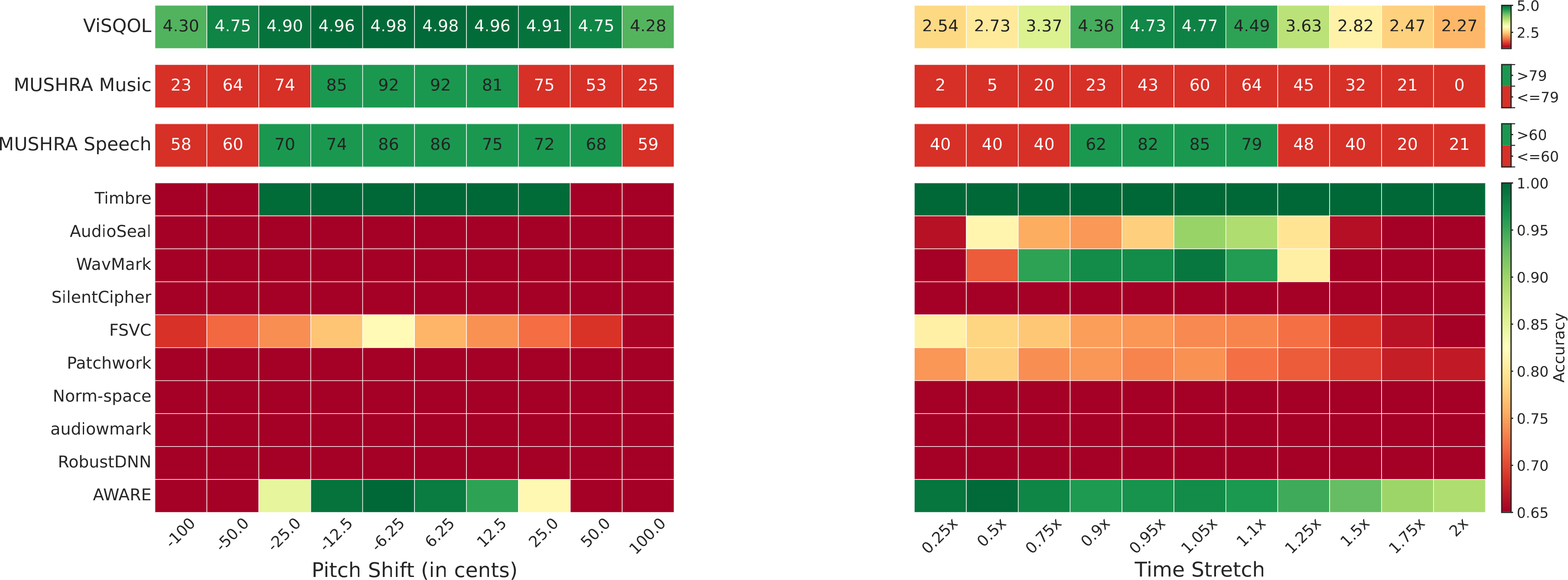
Heatmap of watermark bit recovery accuracy and perceptual quality under pitch-shift and time-stretch attacks. Quality thresholds: ViSQOL > 3.0, MUSHRA-Music > 79, MUSHRA-Speech > 60.
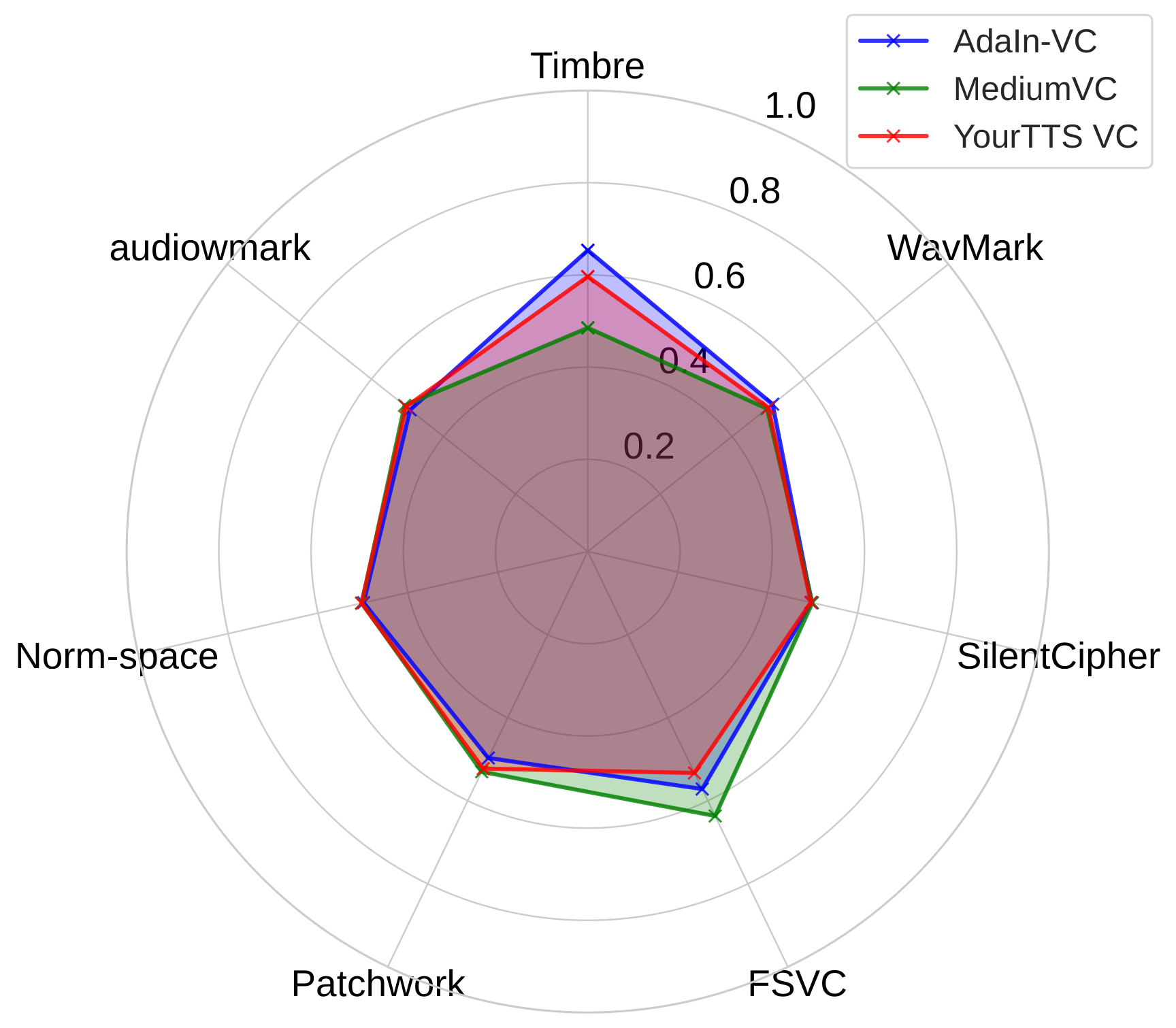
Voice conversion and TTS regeneration preserve perceived speech utility while discarding watermark traces from the waveform.
 Zero-shot VC
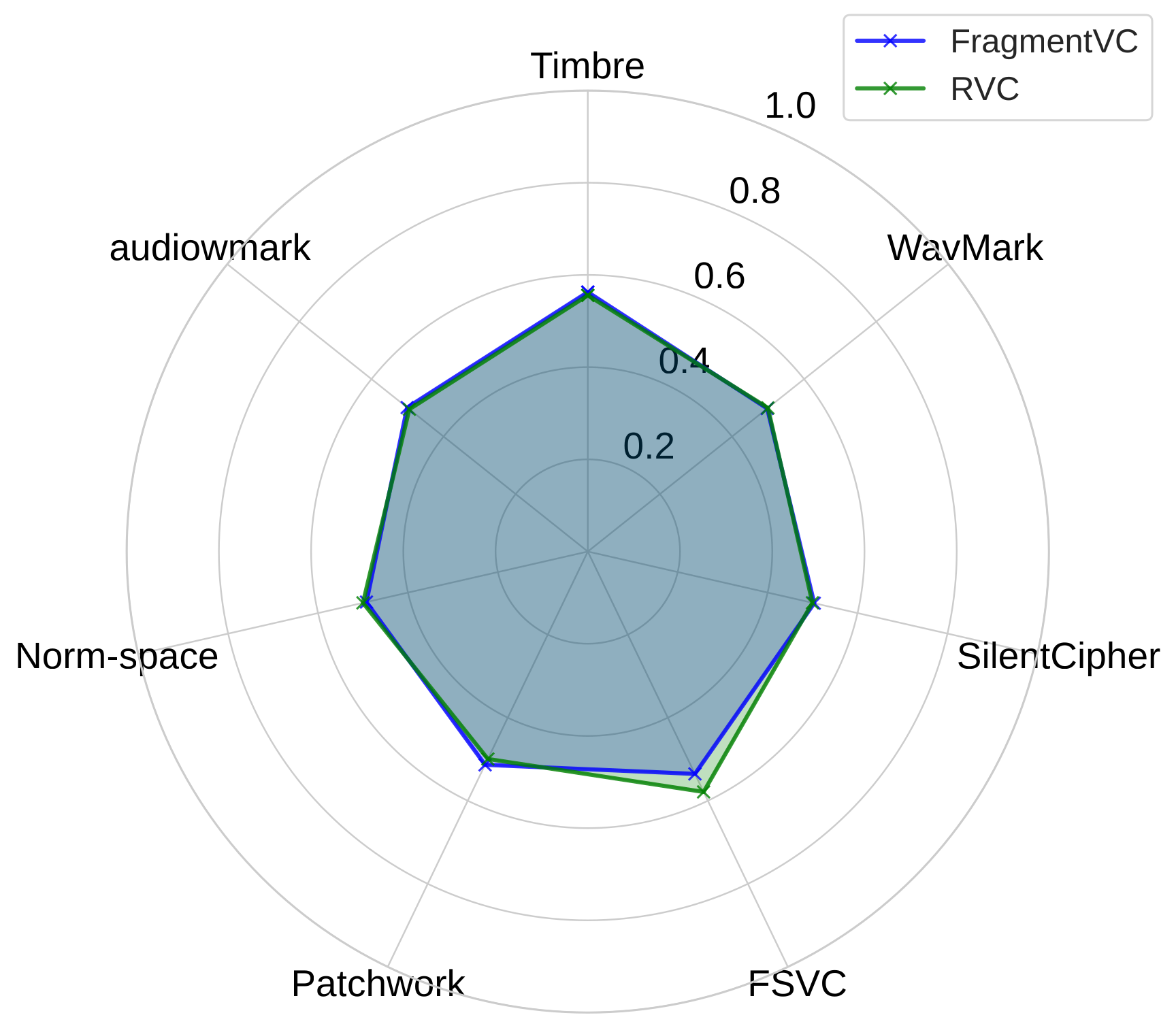 Few-shot / Adaptive VC
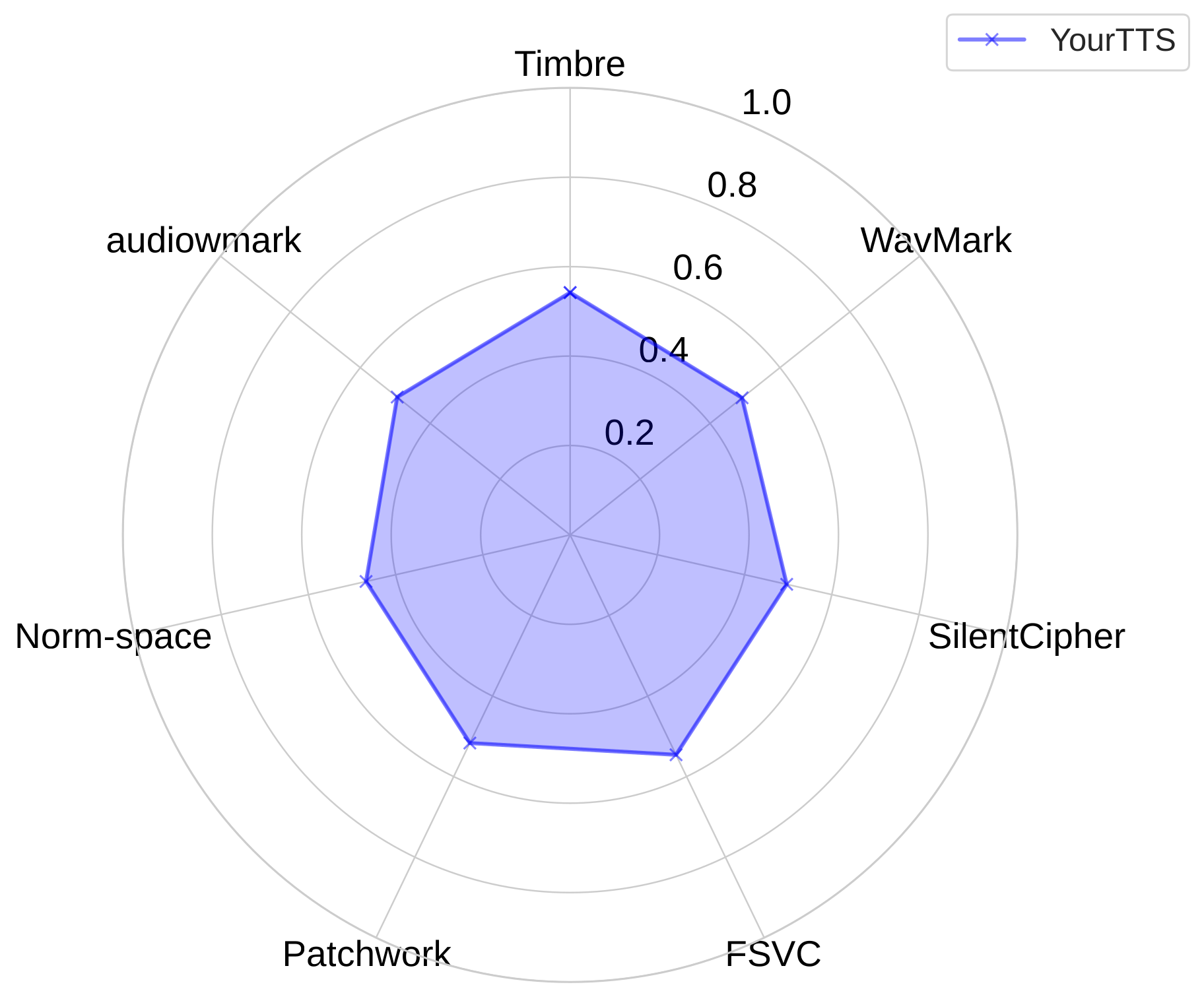 Zero-shot TTS
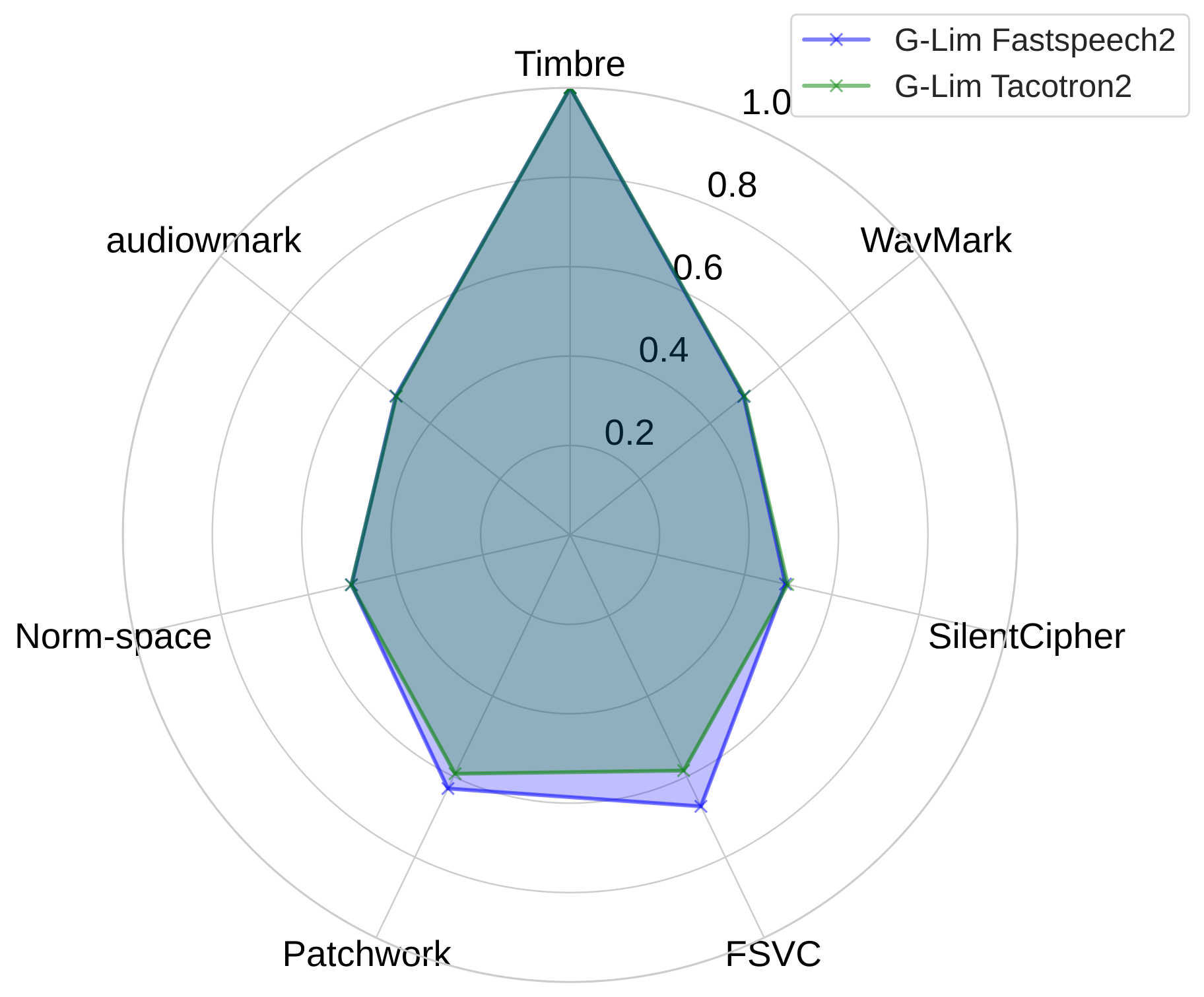 TTS + G-Lim
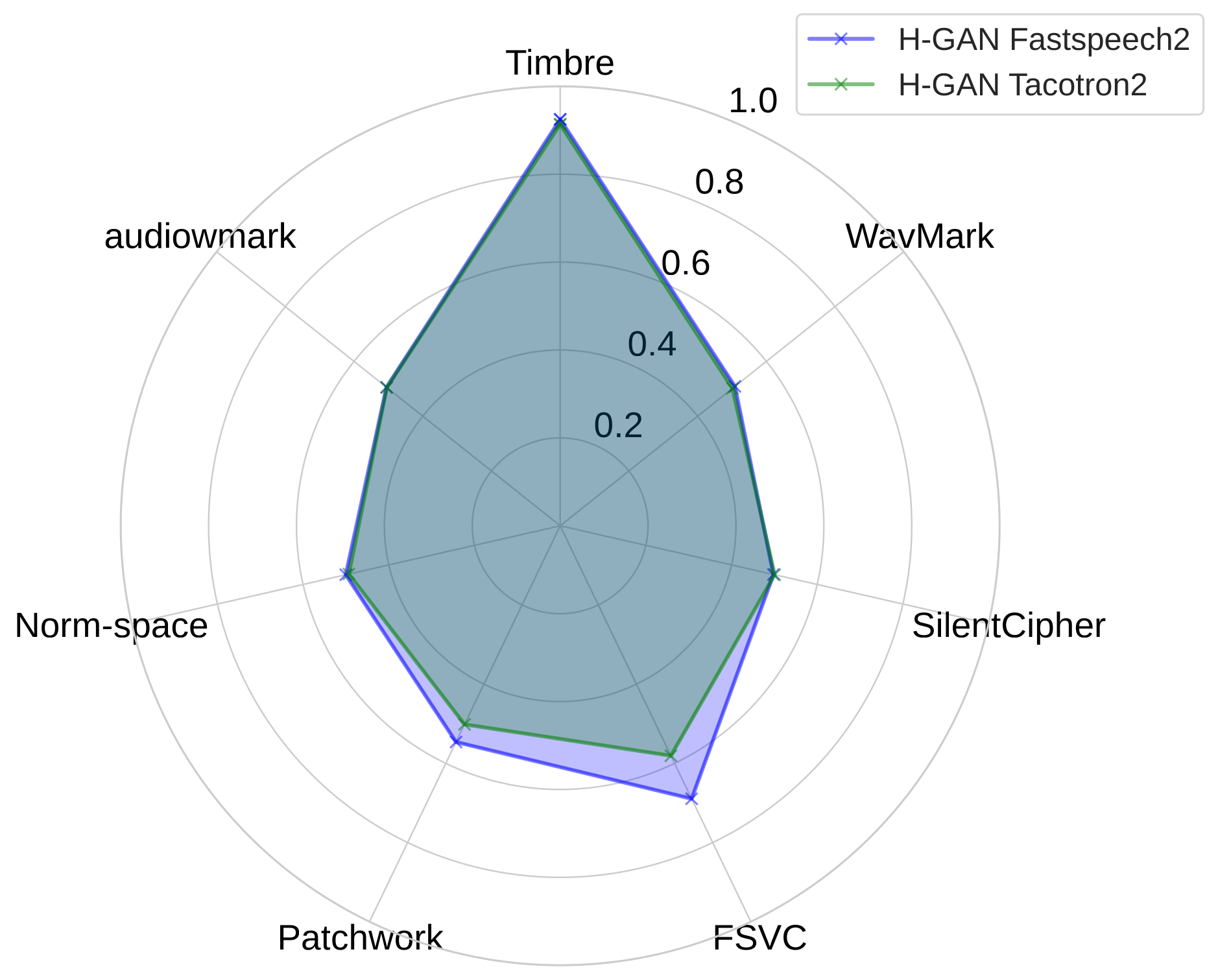 TTS + H-GAN
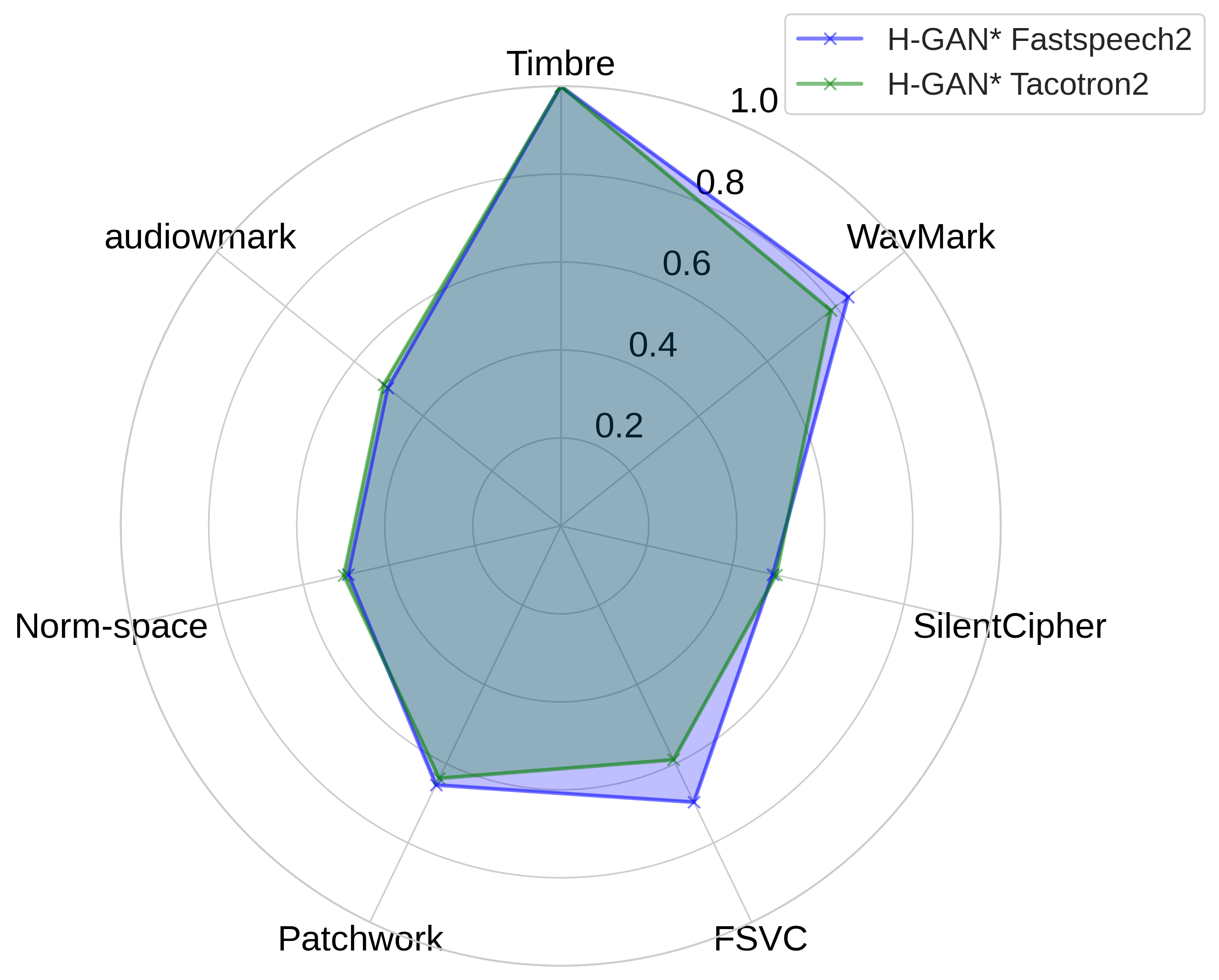 TTS + H-GAN*
| Metric | No Attack |
Voice Conversion | Text-to-Speech | ||||||||||
|---|---|---|---|---|---|---|---|---|---|---|---|---|---|
| AdaIn-VC | FragmentVC | YourTTS VC | MediumVC | RVC | YourTTS | Tacotron2 | FastSpeech2 | ||||||
| G-Lim | H-GAN | H-GAN | G-Lim | H-GAN | H-GAN | ||||||||
| Zero-shot | Zero-shot | Zero-shot | Few-shot | Adaptive | Zero-shot | Adaptive | Adaptive | Adaptive* | Adaptive | Adaptive | Adaptive* | ||
| ViSQOL | 4.87 | 3.82 | 3.02 | 3.96 | 2.54 | 4.04 | 2.35 | 1.81 | 2.69 | 2.72 | 1.82 | 2.71 | 2.75 |
| SECS | 0.99 | 0.84 | 0.75 | 0.90 | 0.67 | 0.93 | 0.83 | 0.69 | 0.87 | 0.87 | 0.71 | 0.89 | 0.90 |
| MUSHRA-Speech | 100 | 70 | 64 | 65 | 76 | 97 | 78 | 81 | 85 | 78 | 79 | 96 | 72 |

Listen to representative audio samples for each distortion setting. Samples are grouped by distortion type. Expand a group to browse individual settings, then expand a setting to listen to more samples.